6K+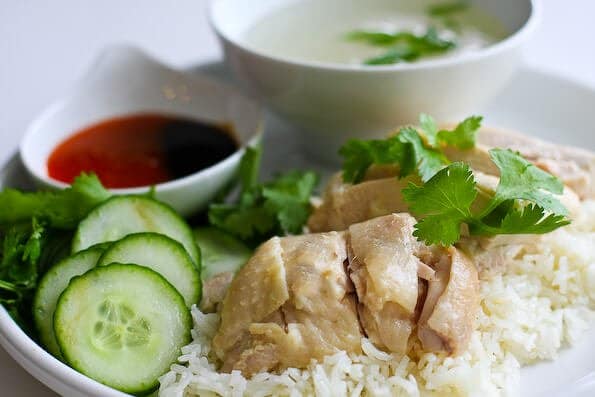
What you’ll learn:
- Choosing the right chicken for your Hainanese Chicken Rice
- How to cook the perfect Hainanese Chicken
- The best way to prepare Hainanese Rice
- Preparing Chilli dipping sauce for Hainanese Chicken Rice
Hi there! Please welcome guest writer (and Steamy Kitchen intern) Jess from
Jess’s Many Mini Adventures in Food and Farming.
She’s an amazing, passionate gal who loves food as much as I do. She’s
here to share her family’s Hainanese Chicken Rice Recipe.
-Jaden
Hey all,
Jess here, Steamy Kitchen’s new intern. That’s me chewing on a mango in my tiny kitchen preparing for a meal at Synergy Farm
(a farm on an island!) where I intern at. I’m actually in my kitchen
right now on my lunch break, looking out at the barn and the carrots in
the north garden,  munching
on a quesadilla with beet greens and feeling amazed all over again at
how I ended up here, on a farm, writing to all of you wonderful readers!
munching
on a quesadilla with beet greens and feeling amazed all over again at
how I ended up here, on a farm, writing to all of you wonderful readers!
I’ve been here since late March, just after my 24th birthday. Before
that, I was living in Cambodia helping girls get an education; before
Cambodia, I was working at Google, and waaaaaay back before then (well
not so long ago, actually) I ran an afterschool program in the bay area.
I love adventure, and I love to consider the small ways I can change
the world for the better, and over the past few years, I’ve become
convinced that my way of making my world better is through food.
Growing up in Orange County, California, I never thought much about
where my In-N-Out Burger or spicy tuna roll came from. Every since I was
4 years old perched on a kitchen stool, stirring up Betty Crocker, I’ve
always been in love with food: cooking it, eating it, playing with it. I
love cooking with friends; chopping veggies gives me a high like no
other; but it was only recently that I’ve become fascinated with how our
food is grown, processed and distributed to us and also how it affects
our health, our environment and our communities. I figured it made sense
to get down in the dirt and learn more about these issues firsthand, so
I became an apprentice on a small organic farm in the beautiful San
Juan Islands.
So what’s all this got to do with blogging? The food blogging
community has been a way for me to connect with other people who think
and care about food as much as I do. I’m completely inspired by all the
amazing folks out there sharing their recipes and opinions and lives.
Jaden’s agreed to transmit some of her samurai skills in cooking and
food writing to me so I can join in the fun.
All this food love had to come from somewhere, and I tend to
attribute a lot of it to good genes. My mum’s side of the family is
Singaporean and I grew up in a whirlwind of popiah, freshly baked curry
puffs, and beef rendang. Though I’m open to all kinds of cuisines, I
hold a special place in my heart for a good plate of chili crab or
chicken satay.
When I was small my family made many trips to my grandparents’ house
back in Singapore. Early in the mornings, before it got unbearably hot,
my grandpa would head down to the local hawker center (a food court with
lots of different stalls) to pick up breakfast. He would come back to
the house with a bag full of packets wrapped in banana leaves, still
hot, shiny with oil, and intensely fragrant. We’d each carefully unwrap
our packet, uncover the pieces of tender, perfectly steamed chicken on
top of savory rice. We’d tuck in to the fragrant ginger-garlic-chickeny
heaven, topped in our favorite combinations of magical sauces and eat
till we were ready to face the sticky tropical day.
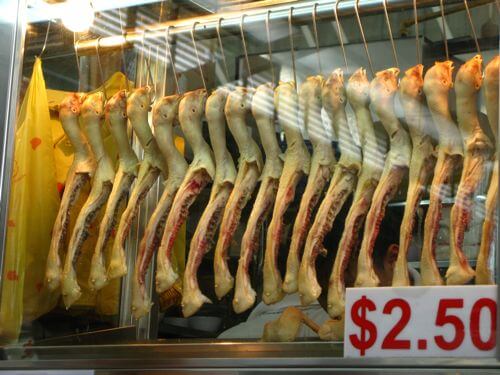
These days you can still find Hainanese chicken rice in hawker
centers across the island for a couple of dollars a plate, and also in
high-end restaurants serving up authentic cuisine. This is what a hawker
center looks like — like a mall food court, only with mee goreng and
peanut soup instead of Sbarro!

Hainanese Chicken Rice often called Singapore’s national dish. When I
was a kid and my family would go back to visit Singapore, I had three
loves: fried bananas, paratha, and chicken rice. When I was visiting
family last November, it was one of the first things they took me to eat
— the carcasses in the stall beckoned to me with the promise of
super-fresh tender chicken — some things just don’t change.
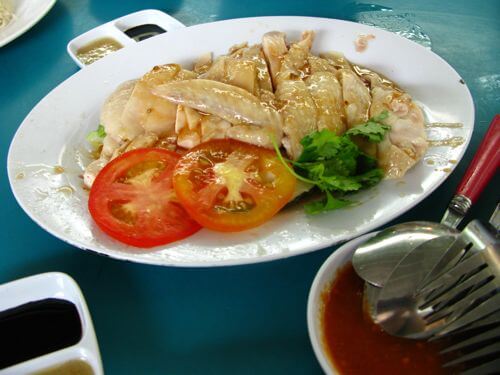
Though Hainanese Chicken Rice gets its name from its origins in
Hainan, China, it was really when overseas Chinese brought the dish to
Singapore that it got a new personality and became famous.
According to my mom, this recipe is really only authentic when made
with a “kampong” chicken, which means basically, a chicken from the
village: the kind that roam around in the sun and eat whatever grubs and
grass and scraps of rice are available. These kinds of chickens look
pretty skinny by our standards, but they have an amazing flavor that I
can only describe as “extremely chickeny.”
Here on the farm, we raise the closest equivalent to a “kampong”
chicken that you’ll likely find in the US — not as scrawny, but pretty
much as delicious. Our chickens are organically fed and pasture-raised,
which means they get to spend their days outside, hanging out in the
sun, roam in the grass, pecking at greens and grubs. We raise about 120
in each batch and they take about 8 weeks to go from chick to chicken
rice. As my mentor, Farmer Susan likes to say, these chickens live a
really really good life and then have one really bad day. They are
ridiculously good just boiled plain in a pot of water and salted
slightly.

All that good care makes these chickens more pricey than your average
bird and on a farmer’s salary, it’s tough to afford them, but
thankfully in our chicken processing just a couple weeks ago, I was able
to snag a couple of tiny 2-pounders that we wouldn’t be able to sell,
that were just perfect for chicken rice.
Hello guys and gals, it’s Jaden back again – Jess gave me her recipe
for Hainanese Chicken Rice and I made it to show you step by step
instructions! It’s a multi-step recipe, with 4 components:
1) Chicken
2) Rice
3) Chili Dipping Sauce
oh yes, the soup too, but you don’t really have to do much other ladle into the bowls.
So, let’s start with the CHICKEN.
How to cook Hainanese Chicken
This is an organic supermarket chicken (I wish we were all as lucky
as Jess to be able to have fresh chicken!) Here’s the deal about the
chicken. You gotta buy the best. Because this Hainanese Chicken Rice
dish is all about the pure taste of the chicken, you really want to go
with organic. It’s worth the money for your health, the environment and
taste buds.
When you buy a whole chicken and are cooking it skin-on, and
ESPECIALLY if you’re steaming or poaching the thing, you want to make
sure you get the “nasties” off.
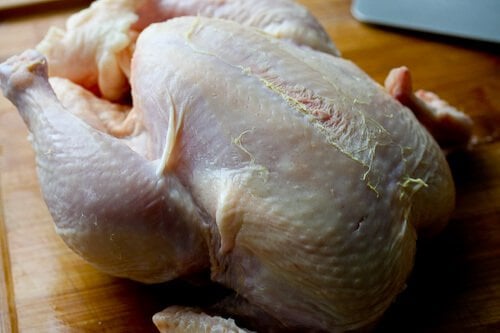
I’m sure by looking at this photo you know what I mean. What I’m after is smooth, unblemished skin.
So I give my guy a facial.
Yes, I’m totally serious!
I exfoliate my chicken.
Wow, I can’t believe I just confessed to you that I give my chickens a
spa treatment. Please don’t think I’m strange! Please tell me that you
do this too!??????
Start with a small handful of kosher salt. Regular table salt is too
fine to use to exfoliate. Sea salt is too expensive. Just use kosher
salt. Oh and even if you don’t have that loose skin on your chicken, it
doesn’t mean you don’t need to exfoliate — there’s still hidden guck and
yuck that is trapped in that chicken skin. TRUST ME. Your chicken will
look and taste better this way.
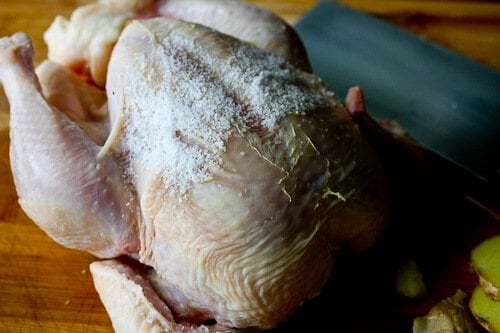
Now RUB RUB RUB!!
Be gone wrinkles!
Be gone trapped guck!
Be gone dead skin! <- i="" know="" levels.="" many="" on="" p="" ridiculous="" so="" sounded="" that="" yes="">
Work those pores!
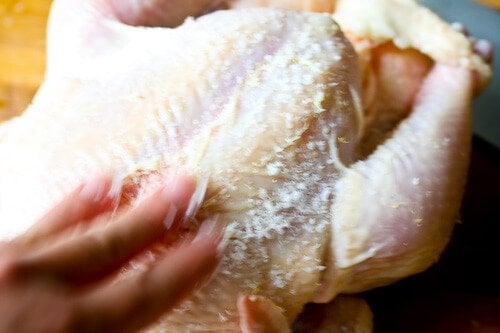
Rinse, pat dry and ta-da!!!
Glistening.
Glowing.
Soft.
Smooth.
Taut.
Chicken.
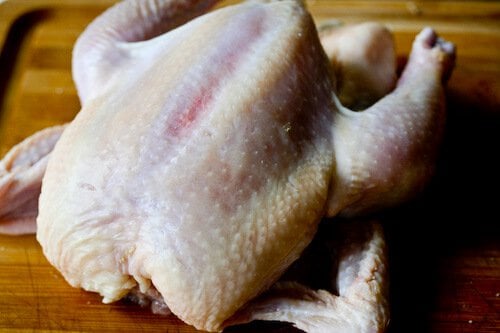
Check those lovely pores.
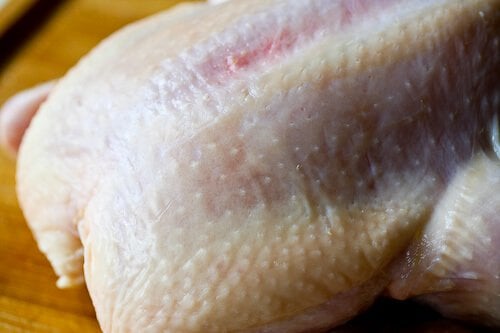
Season the inside and outside the chicken with salt and stuff the
bird with ginger and green onions. Remember, you are not only seasoning
the chicken, but also the poaching water too, so be generous with the
salt. I generally double the amount of salt that I would normally use on
a chicken. I’ll show you how much water we’re adding in a sec.

Put it in a big pot and fill with water to just cover by 1 inch. Note
that some of the stuffing might fall out. Which is totally okay. Don’t
worry.
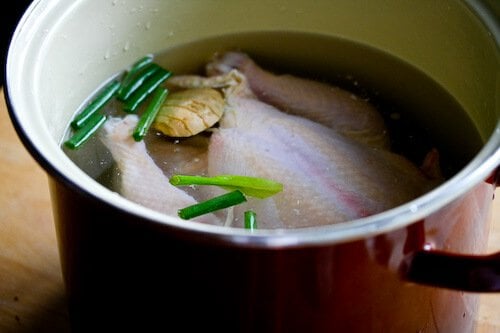
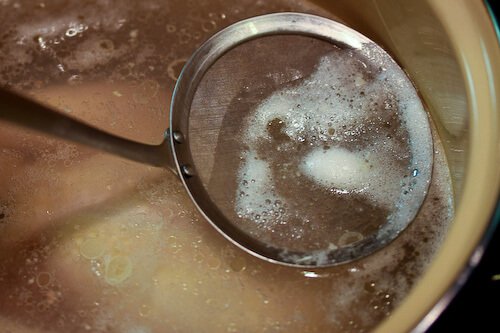
Bring that baby to a boil and then immediately turn the heat to low
to keep a simmer. You’ll begin to see some of that scum. Now hey, if we
didn’t exfoliate our chicken, I bet that scum would be a lot browner. I
have a handy dandy
scum skimmer. If you don’t have a scum skimmer, buy one, it’s only $2!
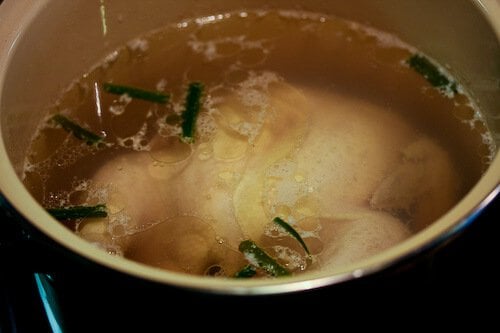
After simmering on the lowest heat (just enough for little tiny
bubbles to break surface) and your chicken reaches the correct temp
(take the chicken temperature at the thickest part of the thigh that’s
not touching bone, it should read 170F). This is is done!
Prepare an ice bath and immediately lift the chicken out of the pot with 2 big slotted spoons or 2 big fat spatulas.
Here’s a tip.
Don’t try to grab the chicken legs to pull the chicken out. You’ll end
up tearing the skin and heh, maybe even tearing the drumsticks outta the
chicken which results in you standing there holding two drumsticks and
the rest of the chicken plopping back into the boiling hot broth which
then splashes back on your arms and face. Speaking from experience, of
course.
Oh, and don’t even THINK about pouring that clean, delicious broth
down the sink! We’ll be using that to cook the rice, prepare the sauce
and to drink as soup! So, remember, gently lift the chicken out from
under and try not to disturb its delicate (and exfoliated!) skin.
My pot of ice water wasn’t big enough, but it worked, I just turned
the chicken over a few times to make sure both sides were cooled. Why
are we doing this, you ask!? Ha! I thought you’d never ask. Well let me
tell ya. Plunging in an ice bath stops the cooking process immediately
AND tightens the skin, making it springy and firm. The quality of the
chicken skin is important in this dish! It’s all about the skin texture.

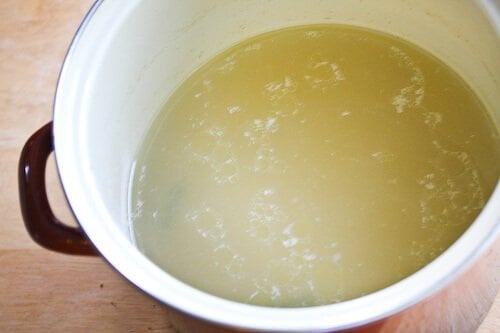
See here? That’s your soup! Season with salt if necessary.
How to cook Hainanese Rice
I use Jasmine rice, or long grained rice. Of course, feel free to sub
with whatever rice you want, but I prefer Jasmine white rice. I’m using
2 cups of rice. Rinse the rice grains several times in water to get rid
of excess starch and other rice cling-ons. Then let the rice soak in
water for 10 minutes.
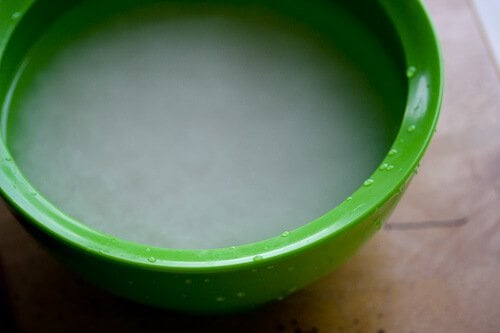
Drain the rice completely, as much as possible.
Grab a pot and saute the garlic and the ginger. Mmmm…can you smell that??

Add the drained rice to the pot.
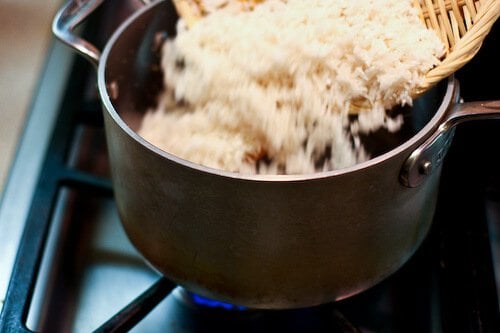
Fry the rice grains for a couple of minutes…this gives the rice SO
much flavor! I like to add a bit of salt to the rice if the broth isn’t
already salted.
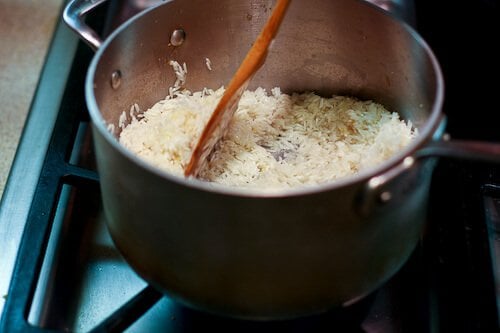
Remember that broth? Well, pour 2 cups of this into the pot. Normally
when cooking rice, I’d go with a ratio of 1 cup rice : 1.25 cups
water/broth. But since we’ve already soaked the rice and the rice has
absorbed some of the water, I’m going with 1:1. Bring the rice to a
boil, then immediately turn the heat to low, cover tightly and cook for
15 minutes. Remove from heat and let rest (still covered! no peeking!)
for 5-10 more minutes. Done.
Oh, if you have a rice cooker, even better! After sauteing the
garlic, ginger, rice – just add that into your rice cooker with the
broth.

Perfect rice.

Chili Sauce for Hainanese Chicken Rice
If you’re a fan of sriracha chili sauce, this will knock your socks
off. Jess puts sriracha, lime, sugar, salt, couple tablespoons of that
lovely chicken broth, garlic and ginger into a blender and
wheeeeeee:

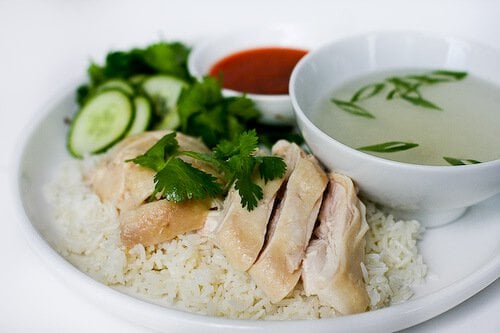
Voila….Jess’s Hainanese Chicken Rice:
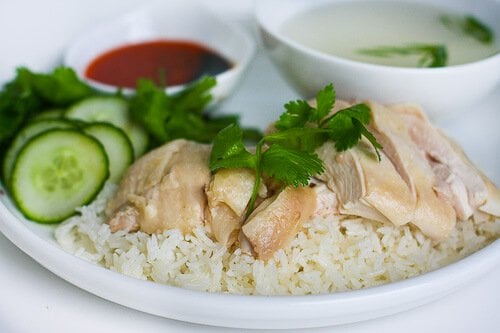
Enjoy!

Hainanese Chicken Rice Recipe
Servings: 6
Prep Time: 20 minutes
Cook Time: 1 hour
While
your chicken is cooking, it helps to prepare the ingredients for your
chili sauce and rice. Both of these are usually assembled after the
chicken is done because they require the chicken broth, but you can get
started washing and soaking the rice, chopping the garlic and ginger
before then. In this recipe, all of the poaching broth is reserved --
some is used in the rice, a small amount is used in the chili sauce, and
the remainder is saved to be heated and served as a simple soup to
accompany the chicken.
Ingredients:
1 whole chicken (3.5 lbs, 1.8kg), preferably organic
kosher salt
4'' section of fresh ginger, in 1/4'' slices
2 stalks green onions, cut into 1" sections (both the green and white parts)
1 teaspoon sesame oil
FOR THE RICE
2 tablespoon chicken fat or 2 tbsp vegetable oil
3 cloves garlic, finely minced
1'' section of ginger, finely minced
2 cups long-grain uncooked rice, washed and soaked in cool water for 10 min or longer
2 cups reserved chicken poaching broth
1/2 teaspoon sesame oil
1 teaspoon kosher salt
FOR THE CHILI SAUCE
1 tablespoon lime juice
2 tablespoon reserved chicken poaching broth
2 teaspoon sugar
4 tablespoon sriracha chili sauce
4 cloves garlic
1'' ginger
a generous pinch of salt, to taste
FOR THE TABLE
1/4 cup dark soy sauce
Few sprigs cilantro
1 cucumber, thinly sliced or cut into bite-sized chunks
Directions:
1. To
clean the chicken, with a small handful of kosher salt, rub the chicken
all over, getting rid of any loose skin and dirt. Rinse chicken well,
inside and outside. Season generously with salt inside and outside.
Stuff the chicken with the ginger slices and the green onion. Place the
chicken in a large stockpot and fill with cold water to cover by 1 inch.
Bring the pot to a boil over high heat, then immediately turn the heat
to low to keep a simmer. Cook for about 30 minutes more (less if you're
using a smaller chicken). Check for doneness by sticking a chopstick
into the flesh under the leg and see if the juices run clear or insert a
thermometer into the thickest part of the thigh not touching bone. It
should read 170F.
2. When the chicken is cooked through, turn off the heat and remove
the pot from the burner. Immediately lift and transfer the chicken into a
bath of ice water to cool and discard the ginger and green onion. Don't
forget to reserve the poaching broth for your rice, your sauce, and the
accompanying soup. The quick cooling will stop the cooking process,
keeping the meat soft and tender, and giving the skin a lovely firm
texture.
3. To cook the rice: Drain the rice. In a wok or sauce pan (use a
medium sauce pan if you plan on cooking the rice on the stove top), heat
2 tablespoons of cooking oil over medium-high heat. When hot, add the
ginger and the garlic and fry until your kitchen smells like heaven. Be
careful not to burn the aromatics! Add in your drained rice and stir to
coat, cook for 2 minutes. Add the sesame oil, mix well.
To make the rice on the stove: In the same sauce pan, add 2 cups of
your reserved poaching broth, add salt and bring to a boil. Immediately
turn the heat down to low, cover the pot and cook for 15 minutes. Remove
from heat and let sit (with lid still on) for 5-10 minutes more.
To cook rice in a rice cooker: Pour aromatics and rice (after frying)
into your rice cooker, add 2 1/2 cups of your reserved poaching broth
and salt. Follow the instructions for your model (usually this will just
mean "turn it on!")
4. While your rice is cooking, remove the chicken from the ice bath
and rub the outside of the chicken with the sesame oil. Carve the
chicken for serving.
5. To make the chili sauce: Blend your chili sauce ingredients in a blender until smooth and bright red.
6. To make the soup: You should have six or seven cups of the
reserved poaching broth left over to serve as soup. Just before serving,
heat up the soup, taste and season with salt as necessary.
Serve the chicken rice with chili sauce, dark soy sauce, cucumber
slices, and a bowl of hot broth garnished with cilantro or scallions


